Rob Lucien
Infrastructure engineer, open-source advocate, community builder. From Haiti's terminals to Houston's enterprise environments — this is the full story.
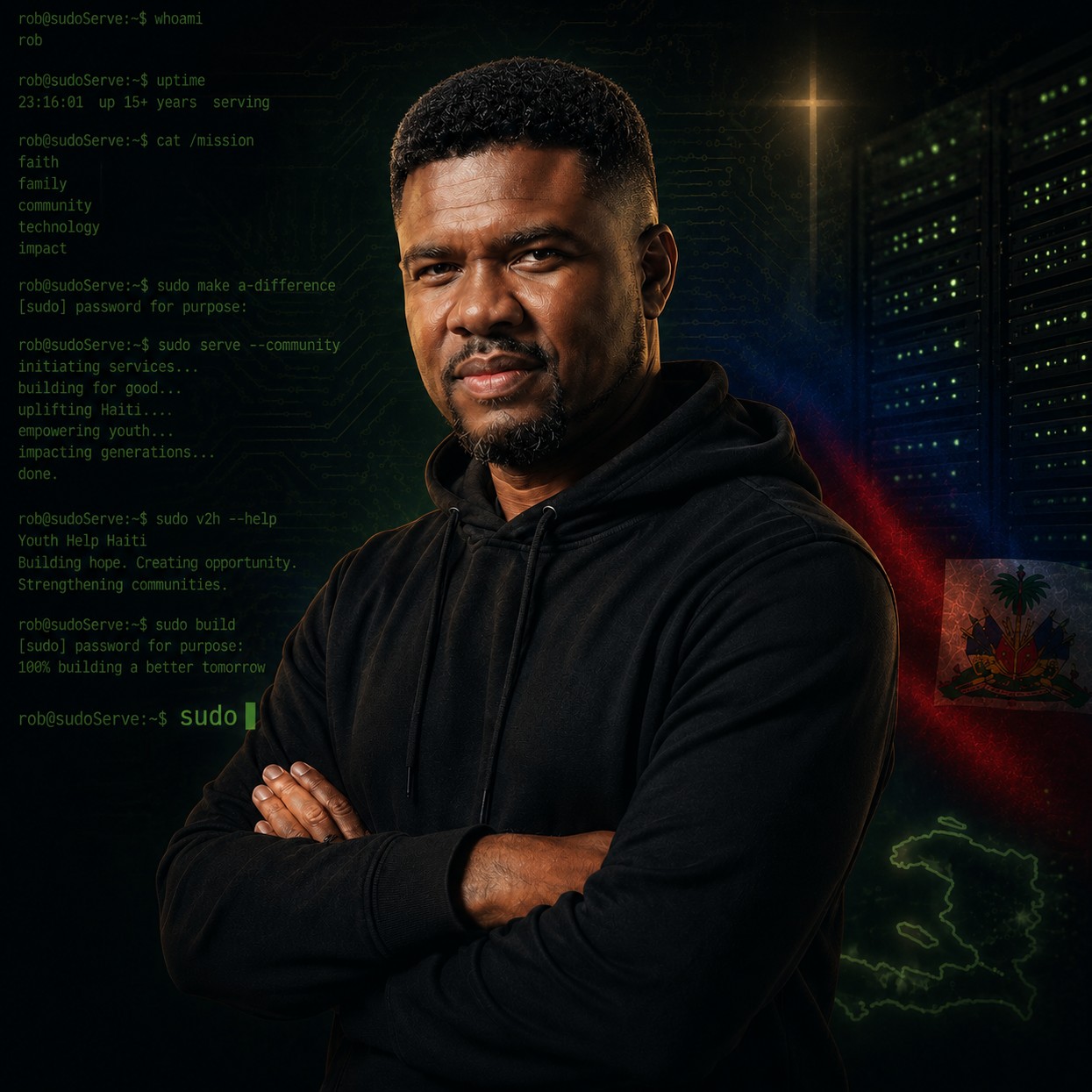
20+ Years at the Intersection of Infrastructure and Purpose
My IT career began in Haiti in 2004, teaching computer fundamentals and managing school lab networks at Institution Saint Louis de Gonzague. That early exposure to education technology planted a seed — not just for technical mastery, but for technology that serves people.
Through the late 2000s and early 2010s, I built and led an IT consulting firm in Port-au-Prince, growing it to a team of six engineers delivering infrastructure solutions to more than a dozen NGOs and enterprises — including multiple USAID-funded programs. That experience forged skills you can't learn in a lab: managing critical systems under real pressure, communicating across technical and non-technical teams, and building infrastructure that outlasts the project.
A defining chapter came when I served as IT Office Manager and Technical Liaison for the Haitian Parliament under the USAID Parliamentary Strengthening Program — deploying enterprise servers, redesigning the LAN, and ensuring the digital infrastructure of a government institution stayed secure and operational.
After relocating to Houston, I continued building at scale — through Conn's HomePlus, through USAID technical roles, and now at Synergy Sports, where I apply open-source technologies, computer vision, and AI to transform sports data analytics. Throughout it all, I've stayed rooted in the conviction that the best infrastructure is invisible because it never fails.
Engineering Philosophy
I build with FreeBSD when I want resilience. With Linux when I want flexibility. With vanilla HTML and JavaScript when I want to go back to first principles.
I always ask — who does this serve? Every architecture decision, every automation pipeline, every system I design is filtered through that question.
I believe in owning your stack, self-hosting your services, and building systems that respect the people who depend on them — their data, their privacy, their digital sovereignty.
The FreeBSD Journey
Where most stop at Linux, I go deeper — into the foundations of UNIX itself.
Beyond Linux: Embracing BSD's Roots
FreeBSD is where I go when reliability, security, and performance are non-negotiable. Its clean architecture, superior ZFS implementation, and decades of production hardening make it the foundation for workloads I care about most.
My homelab runs a Proxmox + FreeBSD hybrid environment with Bhyve virtual machines and Jails for service isolation. It's where I test, learn, and build — a living lab that mirrors real production constraints.
Type-2 hypervisor native to FreeBSD. Lightweight, fast, production-ready.
OS-level containers predating Docker by decades. Isolation done right.
Copy-on-write, data integrity, snapshots, and deduplication built in.
Mandatory access control, capsicumization, and proven security track record.
Why Open Source Matters
Open source isn't just a development model. It's a statement about who owns technology and who it should serve.
Transparency
Open source means the code can be audited, scrutinized, and improved by anyone. Closed systems ask you to trust blindly. Open systems earn trust through visibility.
Community First
The best software is built by communities of people solving real problems together. Contributing back to that ecosystem is both a responsibility and a privilege.
Learn by Building
The open-source philosophy mirrors how the best engineers grow: expose the internals, study the craft, build something real. Curiosity is the core competency.
What's Running in the Lab
I run my own infrastructure. I self-host my own services. I believe in owning your stack.
Let's Build Something Together
Open to consulting, contract work, open-source collaboration, and conversations about infrastructure, community, and mission-driven technology.